
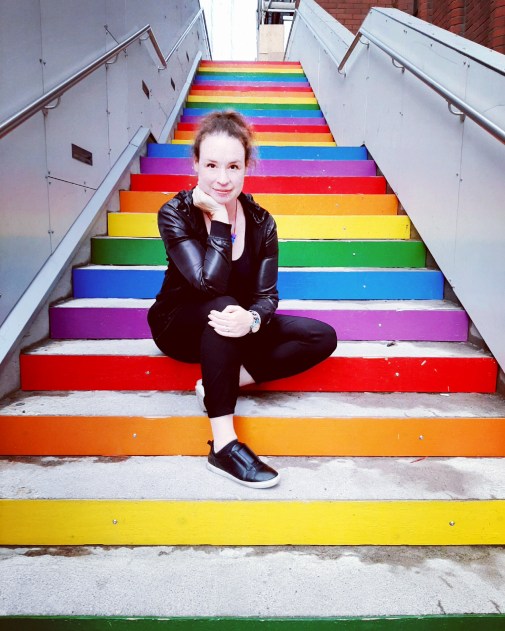
I have been kind of obsessed with rainbows from the beginning—ever since I can remember. I had rainbow bed sheets as a little girl, I wore rainbow ribbons in my hair, tied my shoes with rainbow laces… after all, it was the 80s!
When I was around 9–12, I participated in an organization called “Intermesh Arts.” It was a program arranged by our school district for children interested in music, drama, dance, and visual art. I was in the music division. We attended cultural events together throughout the year and had two-week summer school every year. At the end of the summer school, for the 6th graders’ graduation, we would sing a song most people associate with Kermit the Frog: Rainbow Connection. If you’ve ever listened to or read the lyrics of this song, you know that they are, shall we say, mysterious. Well, as a preteen, I identified immensely with the song and my understanding of its message. I took the lyrics to heart, and there they remain.
It isn’t unusual to love rainbows. Many equate very positive messages with them, for example, hope, keeping promises, love, equality, the calm after the storm… They are beautiful, free, and just rare enough. There’s something about seeing the color spectrum in its perfect order that can be deeply satisfying. If you’ve ever delved into #artteachersofinstagram, you know that there are a number of people, mainly American females about my age, for whom rainbows are serious business. Even if everyone isn’t necessarily organize-your-cookbooks-according-to-ROY G. BIV-level enthusiastic about them, I think it’s safe to say that rainbows are universally considered a good thing. And that’s what the Rainbow Connection is all about. In a world of division—of news that has entire countries of people in a state of collective anxiety—there are still some things that we can agree on. We are all, in fact, “under its spell.”
 Leigh Ann Lindholm