
Sometimes one doesn’t see his or her own culture as “culture.” Growing up, I associated this word with the likes of “other” or “exotic.” Moving abroad has forced me to view my native culture in a new light. I have allowed for the possibility that what was normal to me growing up could also be seen as “other” or “exotic,” and I have found that it most definitely is, in its own way.
I have read many “You know you’re a Southerner if . . .”s and other blanket declarations describing a certain culture, one example being this print that can be found on Etsy:
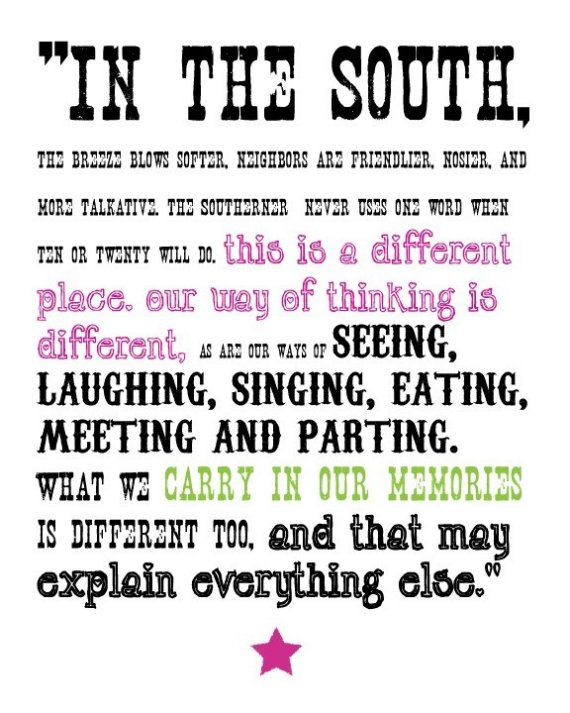
“In the South, the breeze blows softer, neighbors are friendlier, nicer, and more talkative. The Southerner never uses one word when ten or twenty will do. This is a different place. Our way of thinking is different, as are our ways of seeing, laughing, singing, eating, meeting and parting. What we carry in our memories is different too. And that may explain everything else.”
Yes, it’s about pride in where one is from, but there is a good bit of truth in the last part here: a society’s collective memory, including victories, embarrassments, offenses, and trauma, even from generations back, absolutely can affect that culture in the present, and therefore the way each person in that society sees the world.
Two examples of this come to mind. One involves the issue of the Confederate Flag, a highly controversial symbol in my native state of South Carolina and the surrounding areas. It is often interpreted to mean “hate” in regards to race or, seemingly less severe, but potentially just as harmful, “pride.” In Finland, the Stars and Bars can primarily be found in rockabilly culture, associated with a certain type of music, clothing, hair, and cars. The Confederate Flag is not weighted with much value in Finland. I’ve been told the flag can be regarded only as fashion, or at most seen as a symbol meaning “rebel” or not going along with the mainstream, a sentiment also associated with it in the US. Coming from the southern United States, I am always taken aback when seeing it in Finland, although, generally, it is not a taboo symbol here. A fellow American who lived in Finland describes the scene in this blog post.
Another example pertains to one of my all-time favorite movies, The Sound of Music. A couple of years ago, I was studying with a group of Austrian students. As we were talking, I came to realize that almost none of them had ever seen the film. How could a movie so popular not be well-known to people of my generation in western society this day in age? To answer that question, I only needed to consider where they were from, and why this particular movie might not be prevalent there because of traumatic events in the not-so-distant past. A BBC article sheds more light on the subject.
Both of these examples involve significant historical events, which color the lenses of how people perceive current aspects of culture. They exemplify how memories and thinking habits are passed down through generations. In today’s digital society, current western culture can sometimes feel homogeneous. Generally speaking, we all listen to the same music and wear the same types of clothes. We experience Game of Thrones together and give our input in an argument over the colors of a dress. It becomes easy to forget the deeply rooted cultural memories that shape our perception of the world. Do you have any examples of this to share?


Not sure it answers your question, but one area of interest in comparing cultures is that of childbirth and raising children.
You may have watched the BBC series Call the Midwife, which is set in the (poor) east end of London in the 60s. I was born there in that era so I find the issues that are raised really interesting on a personal level.
Fast forward to 1990s and my own experiences of giving birth here in Finland … When I told cousins back home about the antenatal and post natal care and maternity leave support they were impressed, but the wonderful baby box that has been part of the care package for mother and baby for decades (before the Call the Midwife era!) but my London relatives thought it akin to Communism … Horrible that all babies are dressed the same, and how horrible that they have to sleep in a box
I laugh now, but was increasingly frustrated at the time that they didn’t understand that Finland had then -and still has – a very low mortality rate for under 1s. Educating mothers and making simple provision for babies’ needs plays a huge part in that!
LikeLike
Thank you for your comment, Lorna! You raise a very interesting point. I find it intriguing, yet understandable, that your relatives associated the Finnish baby box with communism, one of the West’s ultimate villains of the 20th century. I also find it interesting how that word is thrown around so carelessly in US politics even today!
– Leigh Ann
LikeLike